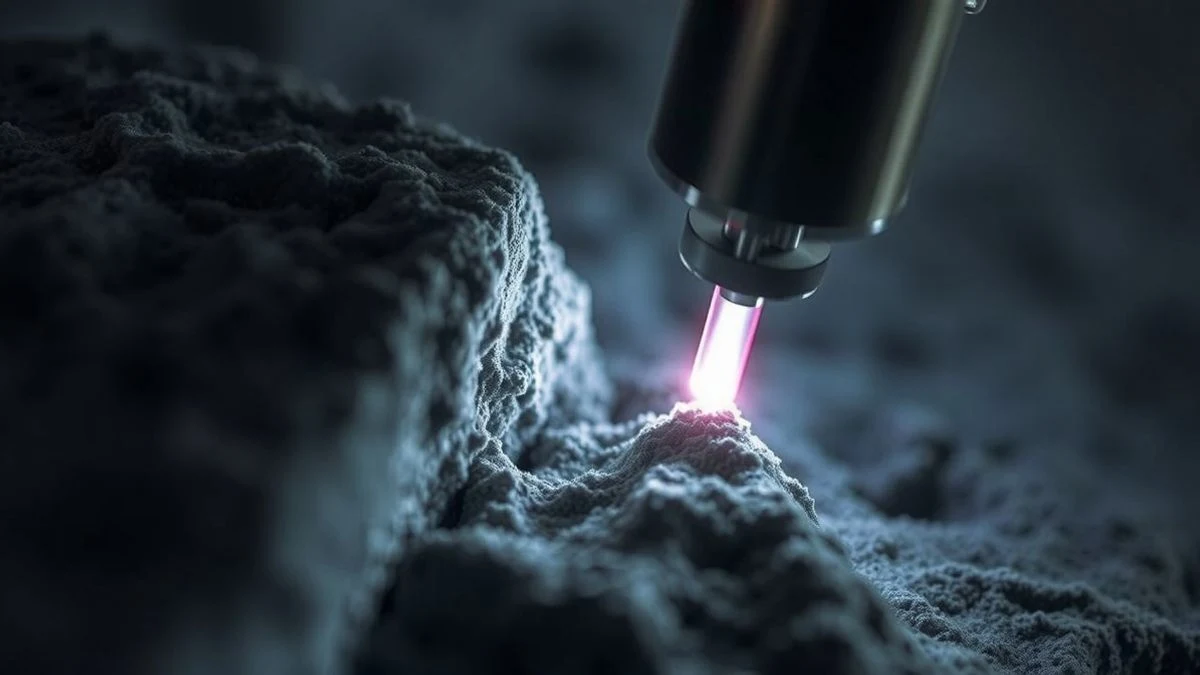
The startup Lunar Forge has developed a laser sintering system that transforms lunar regolith into building material, achieving strengths comparable to steel. The aim is to manufacture protective infrastructure for the nuclear reactors that NASA plans to install on the Moon before 2030.
The American startup Lunar Forge has presented a technology that converts lunar dust, known as regolith, into high-strength building blocks. The system employs laser sintering, a process that melts mineral particles at high temperatures to create solid structures directly on the Moon's surface. The initiative seeks to address one of the greatest challenges of space exploration: the protection of the future nuclear reactors that NASA plans to install on our satellite.
A Material Stronger than Concrete
Laboratory tests conducted by Lunar Forge have demonstrated that the material made from regolith achieves a compressive strength of up to 345 megapascals (MPa). This figure is comparable to that of some structural steels and far exceeds that of conventional concrete, which ranges from 20-40 MPa. The key lies in the minerals present in lunar dust, such as iron, aluminium, and titanium, which allow for the production of a dense and durable material.
The manufacturing process is adjusted using artificial intelligence, which analyses the composition of the regolith in each area and adapts the laser parameters to optimise strength. This enables work with lunar soils of varying quality without the need for constant human intervention.
First Test on the Moon in 2027
Lunar Forge plans to conduct its first test on the Moon in 2027. In this initial mission, it will send a solar-powered manufacturing system that will demonstrate the technology's viability in real conditions. Subsequently, the company plans to incorporate autonomous systems capable of continuously producing infrastructure, without relying on resupply missions from Earth.
The project is part of NASA's goal to have an operational fission reactor on the Moon before 2030. This reactor will be essential for providing energy to future permanent bases and for powering crewed missions to Mars. The shields produced by Lunar Forge would protect the reactor from space radiation, micrometeorites, and the extreme thermal variations of the lunar surface.
Drastic Cost Reduction
One of the main attractions of Lunar Forge's technology is the cost savings on transportation. Currently, sending one kilogram of material from Earth to the Moon costs around one million dollars. By manufacturing the shields on-site with regolith, the need to transport large amounts of concrete or steel is eliminated, significantly reducing mission budgets.
For Spanish aerospace companies and startups, this innovation opens up collaboration opportunities. Companies like PLD Space or GMV could participate in the supply chain of components or in the development of autonomous manufacturing systems. Furthermore, the laser sintering technology applied to lunar resources could have applications in construction in extreme environments on Earth, such as deserts or polar regions.
Lunar Forge has already applied for patents for its process and is seeking investors to accelerate development. The company hopes that if the 2027 tests are successful, large-scale production of shields for lunar nuclear reactors could begin in the early next decade.

You may also like