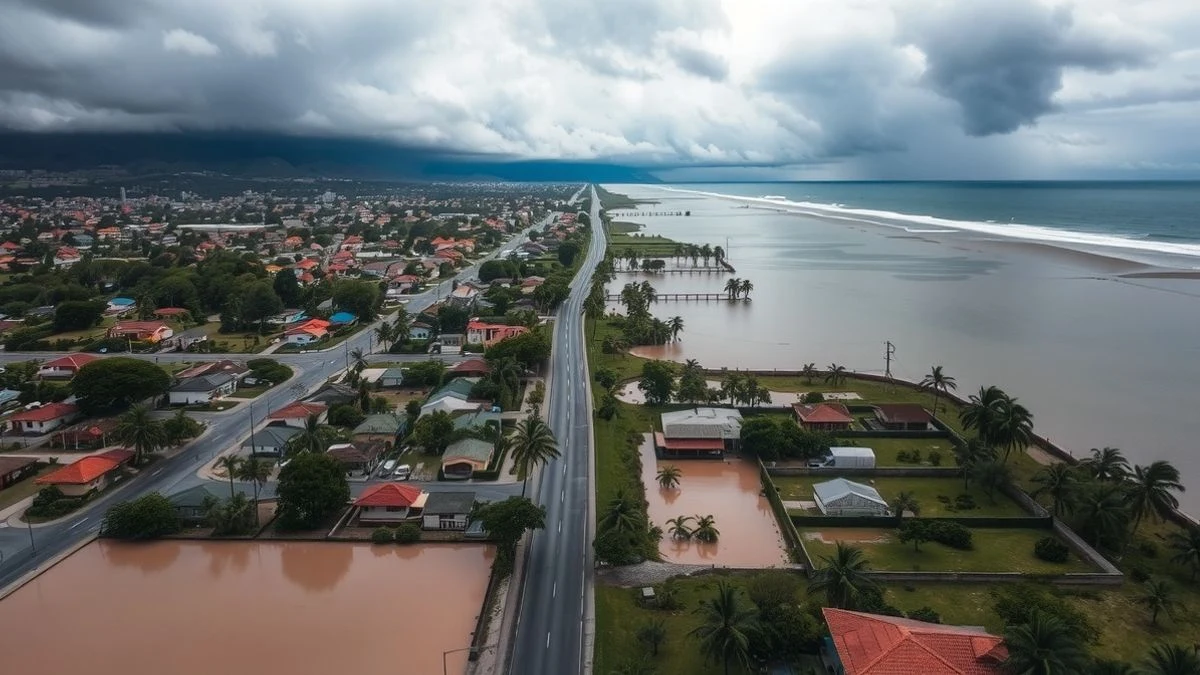
The arrival of the El Niño phenomenon worsens the situation in the Buenos Aires towns of Reta, Claromecó and Orense, where the groundwater is saturated and the streets have become impassable. Municipal delegates are working against the clock to prevent greater damage.
The meteorological phenomenon El Niño is no longer a technical projection: it has come into effect and is hitting the Buenos Aires coasts hard. In towns like Reta, Claromecó and Orense, the excess water accumulated since the rains in May has pushed the groundwater to its limits, and local infrastructures — streets, rural roads and drainage systems — are on the brink of collapse. Municipal delegates are racing against time to ensure accessibility and the safety of residents in the face of a cycle that promises recurring rains and higher flows than usual.
Reta: a wetland where water springs from the ground
In Reta, interim delegate Daniel Civetta described a critical geological situation: “The weather is not helping us at all; the water tables are very high.” He explained that the town's topography, situated on a wetland, causes “water to spring directly from the ground. There are places where you bury a shovel and water comes out.”
This condition has left the urban area in a critical state, with sections where mud prevents normal movement and streets are impassable. The most concerning area is near the lagoon, a low area where the land is “saturated, full, flooded with water,” making it difficult to find drainage routes. Civetta noted that, although they have machinery, using it would be counterproductive: “It’s very difficult to work until some areas are drained a bit.” For now, they are focusing on cleaning and painting tasks while consulting with municipal technicians about possible drainage works for the most critical areas.
Pressure is mounting with the approach of the 3rd Empanada Festival, scheduled for July 26, during the winter holidays. Civetta emphasised the importance of the event: they are working “to ensure it is in the best condition to welcome tourists and also to make sure that the residents of Reta have the town as orderly as possible.”
Claromecó: the stream and the streets under constant surveillance
In Claromecó, the director of the Decentralised Entity Claromecó Tourist Services, Nicolás Felipe, confirmed that excess water is now a constant: “We have been experiencing quite prolonged rains for about 15 days, which have been flooding some streets, complicating accessibility, a lot of mud is accumulating and preventing us from working with the grader.”
The strategy is divided between urban urgency and hydraulic prevention. The immediate plan, coordinated with the municipal Road Entity, consists of “graveling some streets, working directly on certain streets, so that we have some passable for the residents, especially the main arteries.” However, the biggest concern lies with the behaviour of the Claromecó stream. Felipe and the Undersecretary of Environmental Management, Gabriel Francia, are conducting constant inspections, focusing on the Gallego Bridge. “It’s a culverted bridge, a lot of rubbish, plastic, animals come through. It gets complicated even with the plants that the stream brings,” he warned.
Claromecó has a structural advantage: three or four new water discharge outlets to the sea that relieve pressure on the mainland. Their operation is supervised by the Road Entity to control the flow coming from the fields. Felipe noted that “the biggest problem would be for Tres Arroyos; we wouldn’t need to widen the stream.”
Orense: the road, an artificial dam complicating drainage
In Orense, delegate Julián Pérez raised a problem related to the town's design. The replacement of the railway with the road created an artificial barrier to natural drainage. “The road acts like a dam holding back water; our town is divided in half,” he explained. This creates a drainage system that is “complex, complicated and strange” that sometimes tries to force water where it does not want to go.
The main concern, considering the rains that may occur during El Niño, is the movement of water from north to south. “It comes through all the gullies, streams. The last time there was a huge current, it affected pipes, outlets, it seemed like they were going to be ripped out by the speed,” he recalled. To mitigate this risk, the Road Entity has carried out deep cleanings with large excavators at the outlets to the lagoons to prevent water from overflowing into the town.
The state of the rural roads is the most fragile point. Pérez clarified that, regarding the use of heavy machinery on wet soil, “the roads are not in a condition to keep putting machinery on them. The damage you cause is greater than what you will repair.” Therefore, he called for social responsibility from producers and transporters, asking them to “avoid travelling after heavy rains.”
For residents, the situation means impassable streets, difficulties accessing basic services and a constant risk of flooding. Delegates recommend staying informed through official channels and avoiding unnecessary travel during heavy rains. The coming weeks will be crucial to assess whether emergency measures can contain the effects of El Niño.

You may also like