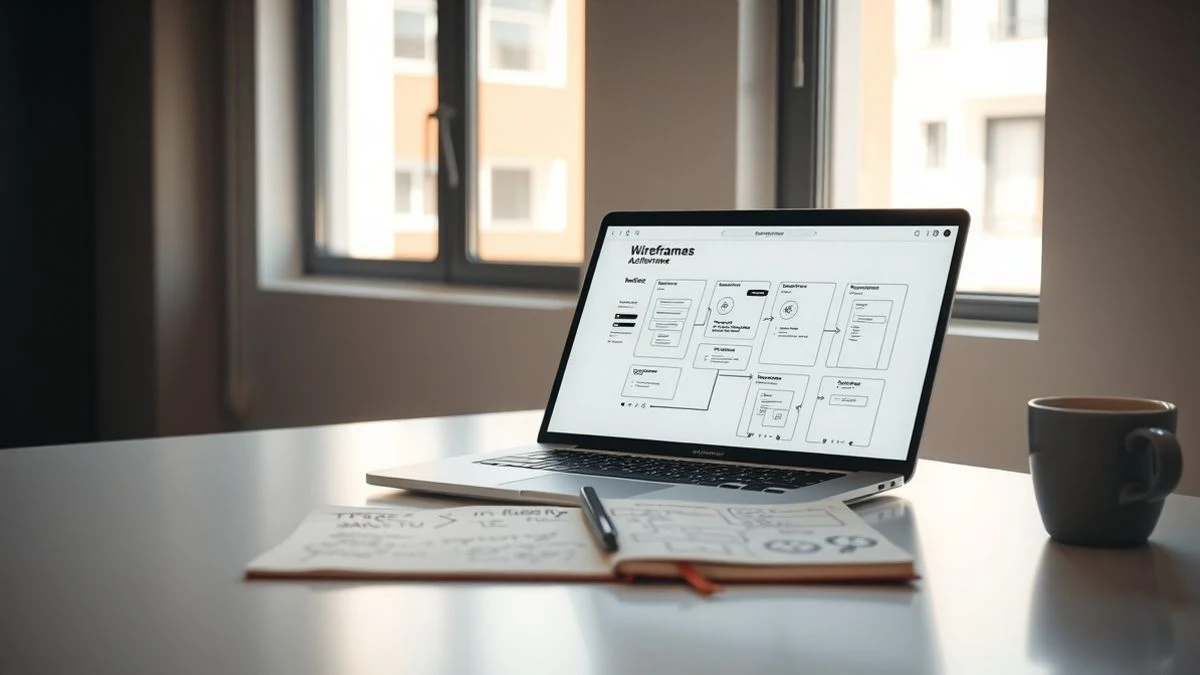
Organisational adoption of AI reached 88% in 2026, according to Stanford. While coding performance nears perfection, design emerges as the true differentiator for startups.
The performance of artificial intelligence in coding benchmarks jumped from 60% to nearly 100% in just one year, according to the latest report from Stanford University. At the same time, organisational adoption of AI has reached 88% in 2026. This exponential acceleration is transforming a fundamental belief in the startup ecosystem: if AI can write almost perfect code, what role does design play in building products?
For founders raising capital or scaling their teams, this question is not theoretical but strategic. The emerging perspective, advocated by experts like Tingyu Su, suggests that the founding designer should be a hire from day one, not a luxury for when product-market fit is achieved.
Design as a competitive advantage in the AI era
The paradox is clear: the more accessible technical building becomes thanks to AI, the more critical design becomes as a differentiator. Startups that do not prioritise design from the outset face a competitive squeeze: on one side, technical commoditisation (anyone can build the same thing); on the other, the inability to retain users due to poor experiences.
According to ecosystem analysis in 2026, many companies in the new wave of AI do not develop models from scratch but rely on existing large models. This means that the advantage is not in the model itself, but in how it is packaged, how it is made usable, and how it solves the real user problem. That is where design stops being about 'making it look nice' and becomes business strategy.
Labour market data shows a clear trend: the demand for hybrid roles such as AI Product Designers or Product Makers is exploding. It is not about hiring a traditional designer to create mockups in Figma, but someone who understands the intersection between AI capabilities, user needs, and technical viability.
What AI cannot replace in your startup
It is tempting to think that with generative AI tools you can skip the design stage. After all, you can generate interfaces, prototypes, and even user flows in minutes. But here is the reality that founders need to hear: AI transforms UX/UI design, but it does not replace the human capacity to innovate and empathise.
Current tools allow for designs based on pre-built kits and rapid prototypes, but product strategy, deep understanding of the problem, and the ability to connect emotionally with the user remain exclusively human skills. A founding designer not only makes the product usable but defines what problem is being solved, for whom, and why the solution is the right one.
In a market where hundreds of startups are building on the same AI models, that strategic clarity is what separates those raising Series A from those stuck in pre-seed. For Spanish-speaking founders, especially in emerging markets like LATAM, where capital is scarcer and global competition is fierce, well-executed design can be the moat that competitors cannot easily replicate.
The risk of postponing design
Many founders make the mistake of thinking: 'first I build the product, then I make it pretty.' In 2026, with the speed of iteration that AI allows, this approach is outdated. Users expect polished experiences from day one, and investors see red flags when design is clearly an afterthought.
Startups that hire founding designers from the start have a structural advantage: they can iterate faster because design and engineering progress in parallel, not in sequence. While a traditional team waits for engineering to finish before design can start, a team with design integrated from day one has already validated flows, prototypes, and experiences.
For founders seeking practical advice, two concrete actions can be implemented this week. First, reevaluate the cap table and hiring plan: if the first technical hire was an ML engineer, consider whether the second should be a product designer with AI experience, someone comfortable with the ambiguity of an early-stage. Second, integrate design into the validation process from day one: do not wait to have a functional MVP, but use high-fidelity prototypes generated with AI to test flows before coding, and involve the designer in user conversations from the outset.
Ultimately, the lesson for the entrepreneurial ecosystem is clear: in a world where AI democratizes technical capability, design becomes the sustainable competitive advantage. It is not an expense; it is an investment in differentiation that pays dividends in user retention and investor confidence.

You may also like