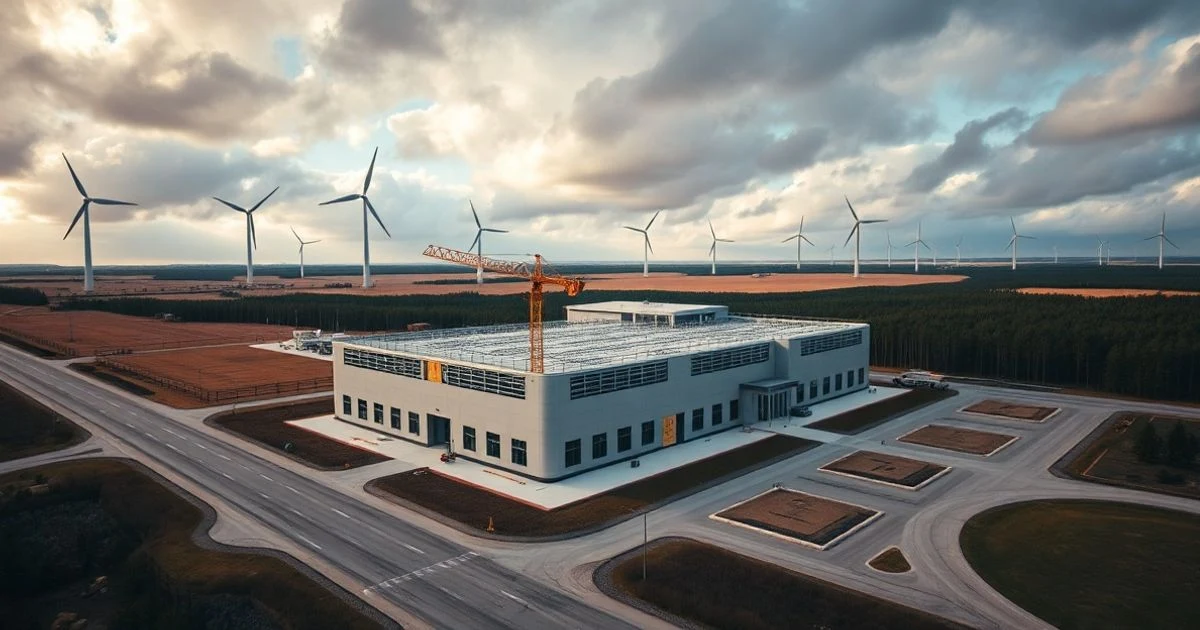
The American chip manufacturer Cerebras plans to activate its first AI data centre in Europe before the end of 2026 and deploy a network of 200 MW by 2027, challenging Nvidia's dominance.
The American company Cerebras, a manufacturer of artificial intelligence chips, has announced an ambitious expansion plan in Europe that includes the installation of its first data centre capacity in the region before the end of 2026. The company expects to build a network of AI centres with a combined power of 200 megawatts (MW) by the end of 2027, initially focusing on France and the Nordic countries.
The decision responds to the growing demand for local AI computing infrastructure from European companies, research institutions, and governments, which are seeking alternatives to the capacity concentrated in the United States and Asia. Electrical power has become the main bottleneck for scaling AI computing, and 200 MW places Cerebras in a considerable infrastructure league, comparable to that of major hyperscalers.
A bet on AI inference and low latency
Cerebras has focused its strategy on chips dedicated to AI inference, the process by which trained models generate responses to user requests. Unlike model training, which requires enormous computing cycles, inference demands quick and low-latency responses, especially in business, scientific, and governmental applications.
Andrew Feldman, CEO of Cerebras, described the project as “massive expansions” worth several billion dollars. During the RAISE summit in Paris, Feldman emphasized that the European demand for computational power for generative AI is growing “very, very quickly,” even faster than the company can keep up. The company expects some of its European infrastructure to support workloads from OpenAI, in a context of strong demand for inference.
Cerebras' promise is to offer fast, high-performance AI computing located in Europe, which is becoming increasingly relevant as workloads become more complex and rely on almost immediate responses. The rise of AI agents, which perform tasks autonomously, also drives the need for chips and computing capacity in companies like Cerebras, Nvidia, and AMD.
Energy, data sovereignty, and competition with Nvidia
Electrical power is a central metric in the AI data centre business, as it defines how much hardware can operate continuously. Small enterprise centres typically consume between 1 MW and 20 MW, while hyperscale facilities can exceed 100 MW. With 200 MW, Cerebras positions itself as a relevant player in a European market that is accelerating its investments to avoid falling behind.
The expansion also responds to the desire for data sovereignty and the need for alternatives to Nvidia, which dominates most AI projects in the region. The American company will compete directly with the chip giant, offering local infrastructure that avoids dependence on data centres in the U.S. or Asia.
Cerebras' plan includes a rapid expansion in France and the Nordic countries, where the availability of renewable energy and the cold climate reduce cooling costs. The company has not disclosed specific locations or local partners but has assured that negotiations are progressing “smoothly.” For investors and European tech companies, Cerebras' arrival represents an opportunity to diversify the supply of AI computing capacity, which has so far been highly concentrated.
The first data centre, expected before the end of 2026, will mark the beginning of a network that could change the landscape of AI infrastructure in Europe. The company hopes that by 2027, the 200 MW will be operational and serve both private clients and public institutions.

You may also like